
What criteria should I use to choose a logistics provider that suits my business?
Your business is growing by the day, and your garage is starting to overflow with stacked boxes. It’s a wonderful problem to have, but according to e-commerce experts, this daily chaos marks the exact tipping point where ‘in-house’ order fulfilment starts to hold back your growth. It’s therefore essential to consider outsourcing your supply chain to unlock your potential and focus on your sales.
For your end customer, the delivery driver at the door directly represents your brand. If a parcel arrives late or damaged, customer satisfaction surveys show that the customer does not blame the carrier; they hold you solely responsible. In practice, finding an excellent logistics provider (also known as a 3PL, or Third-Party Logistics provider) therefore amounts to choosing the true guardian of your reputation and your customer relationships.
Delegating this crucial step often raises legitimate concerns about losing direct oversight of your products. However, adopting a professional logistics solution does not mean relinquishing control, but rather transforming a simple shipping chore into a genuine strategic asset. Let’s explore together how to select the ideal partner to support your success.
3PL or 4PL: Choosing the right level of outsourcing to optimise your budget
As your business grows, managing boxes is no longer the best use of your time. When considering outsourcing, the difference between a 3PL and a 4PL provider lies in your fundamental need: do you need physical ‘hands’ for execution or a strategic ‘brain’ for coordination?
Finding the right logistics provider depends entirely on your team’s in-house expertise and your budget. A 3PL provider focuses purely on physical logistics, whilst a 4PL oversees the entire supply chain ecosystem. Here’s how their responsibilities are divided:
- 3PL (Operations): Receives your stock, stores products securely and dispatches daily orders directly to your customers.
- 4PL (Strategy): Acts as a control tower, often managing several 3PLs, integrating software and negotiating transport contracts on your behalf.
While a 4PL frees up your schedule completely, its premium cost generally means it is reserved for very large companies.For most fast-growing brands, a reliable 3PL provider offers the ideal balance between operational relief and cost control.
Strategic Geography: How mapping your customers reduces last-mile costs
Mapping where your customers live is a major advantage in e-commerce logistics. The most expensive part of shipping is the last mile – that final journey from the local depot to your customer’s door. If your main customer base is in Paris, storing your products in a distant warehouse in Marseille makes no sense. Proximity means speed, significantly reduces your shipping costs and lowers your brand’s carbon footprint.
To achieve this level of proximity, assess a logistics partner’s geographical coverage and distribution networks. A provider with strategically located distribution centres ensures that no customer has to wait unnecessarily. By aligning your customer density map with the location of a provider’s warehouses, you guarantee shorter transit times and eliminate the high costs of long-distance domestic shipments.
Avoiding the Black Friday rush: Choose a service provider capable of handling seasonal peaks
Your sales aren’t steady; the festive season and marketing campaigns create massive peaks. To survive without eroding your profit margins during the quiet months, you need a partner that offers true scalability. Their storage capacity and seasonal flexibility must be able to scale up for Black Friday, then scale back in February. Negotiating a pay-as-you-go payment model ensures that you only pay for the space you actually use.
Beyond the physical space, a warehouse must be able to scale up its workforce quickly to prepare your orders. You need written guarantees, set out in a Service Level Agreement (SLA), including crucial flexibility clauses. Check that they have been prepared by asking the following questions:
- Can you triple your packing teams during peak seasons?
- What are the exact costs for short-term storage extensions?
- Do our SLA delivery guarantees decrease during the busy period in the fourth quarter?
- How much notice is required before a major promotion?
Eliminating dispatch errors through IT integration: The key role of the WMS
Selling an item that is out of stock due to a software glitch instantly damages your reputation. This disconnect occurs when your online shop cannot communicate automatically with the warehouse. To avoid this, modern service providers use a WMS (Warehouse Management System), the digital brain that organises their operations. This integration allows your website to tell the warehouse exactly what to pack the moment a purchase is made.
Achieving this level of fluidity requires seamless software integration and WMS interoperability. Insist on real-time stock synchronisation. If stock levels are only updated overnight, you risk selling out-of-stock products during a busy afternoon rush. A continuous connection ensures that as soon as an item leaves the shelf, your website instantly displays the actual quantity available.
This technology also drastically reduces the workload on your customer service team thanks to real-time tracking and tracing tools. By automatically providing live tracking updates to your customers, you prevent them from flooding your inbox with enquiries about the status of their delivery.
Uncovering hidden costs and ensuring financial stability: How to make sense of a logistics quote
A logistics quote is often like a phone bill: the initial quote rarely matches the final bill. A low shipping rate means nothing if additional charges eat into your profits. Protect your profitability by calculating the total cost per order through a thorough analysis of hidden handling costs.
This includes the crucial stage of picking and packing, the physical work involved in locating your item on a shelf and packing it securely.
Service providers charge differently for goods arriving at their premises (inbound) and those leaving (outbound). Keep a close eye on these common hidden costs :
- Receiving charges: Hourly charges for unloading incoming stock from delivery lorries.
- Minimum stock levels: Financial penalties applied if your stock volume falls below a required threshold.
- Packaging materials: Unexpected costs for the cardboard boxes, adhesive tape and bubble wrap used.
Transparent pricing is only meaningful if your partner remains in business. Always assess your partner’s financial stability by checking their operational history and customer references, to ensure that your stock is never tied up due to a sudden bankruptcy.
Turning returns and sustainability into assets: Reverse logistics and CSR
Every retailer dreads refunded orders, but a returned item gathering dust on the warehouse floor represents tied-up capital. To avoid this, you need to closely assess a service provider’s management of reverse logistics and customer returns. An efficient partner inspects, repackages and immediately prepares the returned product for resale, thereby recovering your revenue rather than leaving it on hold.
Modern shoppers also expect the brands they support to demonstrate environmental responsibility. Prioritising CSR commitments throughout your supply chain by partnering with warehouses that hold environmental certifications instantly aligns your operations with your customers’ values. What’s more, you can turn the physical act of unpacking into a strategic marketing win by opting for eco-friendly, bespoke packaging instead of polluting plastic fillers.
The winning tender: Drafting an attractive set of specifications
Finding the right partner requires a formal invitation to tender. This transport tendering process ensures that every bidder provides a quote for the same project. To ensure a fair comparison, you need to know how to draw up transport tender specifications.
This key specification document must clearly detail your product variants (SKUs) and projected seasonal volume peaks so that service providers can immediately understand your actual space and labour requirements. Once these physical requirements have been established, you must define exactly how operational success will be measured using KPIs and logistics performance indicators. Always insist on these five non-negotiable terms in your contract:
- On-time dispatch and fulfilment rates
- Accuracy of order picking and packing
- Maximum tolerance for stock loss (shrinkage)
- Speed of returns processing
- Time taken to resolve issues by customer support
Launch plan: 5 steps to a successful transition and integration
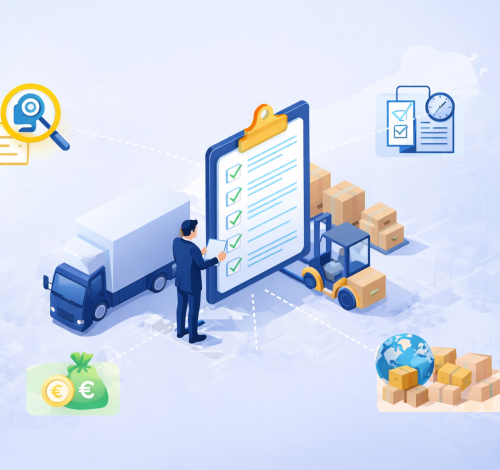
You’ve moved on from feeling overwhelmed by all the boxes to becoming a strategic manager capable of overseeing a logistics partner. To make your decision with confidence, use this final checklist :
- Compile your recent shipping data to establish a clear baseline for volume.
- Rank your options using a weighted evaluation grid based on your unique priorities.
- Check their quality certifications and safety standards to ensure your stock is protected.
- Conduct a trial with a small portion of your inventory before a full migration.
- Establish clear communication protocols to ensure a smooth transition.
Your criteria for selecting a logistics provider now form a clear roadmap for your future growth. The first step is to retrieve your shipping data from last month to establish a solid baseline. This process sets your transition in motion, allowing you to focus on growing your business whilst a trusted professional takes care of the day-to-day operations.