
Top logistics platforms in France: Optimise your supply chain
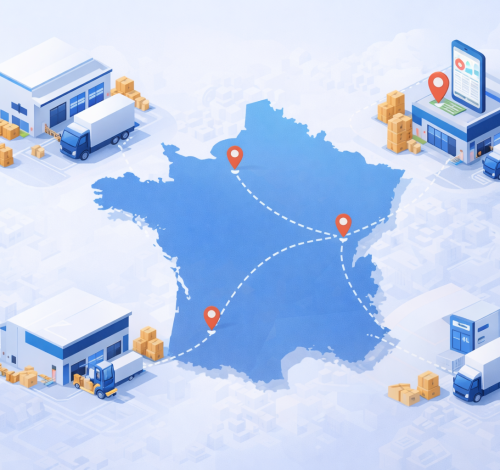
Have you ever clicked ‘Buy’ and wondered how a parcel manages to arrive on your doorstep the very next day? This daily miracle of e-commerce logistics in France relies on a vast and often invisible infrastructure. According to industry experts, the country is home to millions of square metres of buildings dedicated to transport, forming the hidden cogs of our economy.
Although often confused, these huge facilities actually serve very different purposes. A simple warehouse is like a giant ‘safe’ where goods lie patiently in wait to be sold. In contrast, the best logistics hubs in France act as a constantly bustling sorting centre. Goods only pass through them for a few hours to change vehicles before setting off almost immediately for their destination.
To orchestrate this non-stop ballet, the region relies on a vital artery known as the ‘logistics backbone’. This essential north-south corridor links four major cities: Lille, Paris, Lyon and Marseille. Directly connected to the vast European backbone, this key network guides every product with precision, from the moment it is unloaded at the seaport right through to the small electric van driving through your neighbourhood.
Lille, Lyon, Marseille: The three strategic hubs for storing and distributing your products
Since transport is the biggest expense in any supply chain, the location of your stock should not be left to chance. To minimise these costs, companies seek their ‘logistical centre of gravity’: the ideal central point on a map that allows them to deliver to the maximum number of customers over the shortest possible distance. In France, this quest for optimisation has given rise to a backbone running through the country from north to south. It is along this route that the bulk of freight transport takes place.
Far from being mere quiet warehouses where boxes gather dust, major logistics facilities function as highly dynamic sorting centres. These are known as logistics hubs, or more specifically, ‘multimodal hubs’. This term refers to a major hub where goods are transferred from one mode of transport to another seamlessly. Imagine a container arriving by ship, transferred to a freight train, before completing its journey in an electric city van: everything takes place in the same location to speed up the final delivery.
In practical terms, this strategic zone is built on three essential pillars. Choosing the right location will depend directly on where your goods are coming from:
- Lille: The gateway for goods from Northern Europe, offering rapid access to the Belgian and German markets.
- Lyon: The major Alpine hub, ideal for getting closer to French consumer centres and drastically reducing road transport costs.
- Marseille: A key hub for exports and imports from Asia, benefiting from the speed and customs facilities of the port free zones.
Once this geographical footprint has been established, the logistical challenge becomes an organisational one. Knowing where to position your products is a crucial step, but determining who will manage these complex shipping flows on a day-to-day basis ensures the project’s ultimate profitability. The choice between renting your own premises or outsourcing to an external partner raises the question of the 3PL versus 4PL model, thereby determining the level of control retained over the supply chain.
3PL vs 4PL: Outsourcing your logistics without losing control
As soon as a business exceeds fifty daily shipments, managing parcels in-house significantly hampers growth. This is where ‘3PL’ (Third-Party Logistics) comes in. Think of 3PL as your physical extension: this service provider stores your products, prepares orders and hands parcels over to carriers. Outsourcing the storage of goods frees managers from day-to-day stock handling, allowing them to focus on sales.
However, if your supply chain is evolving into a sprawling international network, switching to ‘4PL’ (Fourth-Party Logistics) becomes essential. Unlike 3PL, a 4PL acts as a true orchestrator: it generally does not own its own trucks or warehouses, but manages your entire network by coordinating multiple service providers.
The key consideration in this comparison between 3PL and 4PL comes down to your specific needs: whether to outsource the physical operations (3PL) or the overall strategy (4PL). To estimate the budget required for outsourced logistics, it is important to be mindful of account set-up fees and the IT connection costs involved in linking the online shop to the warehouse servers.
To ensure full transparency during this transition, auditing the prospective service provider is an essential step. A secure handover relies on these fundamental elements :
- Scalable storage capacity: Handling seasonal peaks in activity without overloading the shelves.
- WMS (Warehouse Management System) technology: This warehouse management software provides a real-time view of stock levels.
- ISO certifications: These global standards ensure strict adherence to procedures and a high standard of service.
The validation of these physical and technological safeguards paves the way for day-to-day operations, which are based on specific selection criteria to ensure the security of shipments.
5 Selection criteria to avoid delays and cost overruns
Choosing the right logistics warehouse is a lot like recruiting a key member of staff: communication is key. Software interoperability acts as an invisible translator between your online shop (Shopify, PrestaShop) and the warehouse staff. Without this direct digital connection, every sale would require tedious manual data entry, inevitably leading to dispatch errors and costly delays.
To ensure this process runs smoothly, the operator relies on the WMS. This management software acts as a control centre: it matches the virtual data to the physical box on the shelf, ensuring precise stock management. This helps you avoid a retailer’s worst nightmare: processing a sale for an item that is no longer available.
As soon as the parcel leaves the warehouse, the priority shifts to reassuring the end customer. Requiring your partner to provide real-time parcel tracking is the best defence against post-purchase disputes. By demanding regular updates during transit, you significantly reduce the workload on your customer service team whilst building loyalty among customers who dislike uncertainty.
Beyond technical performance, partnering with an ISO-certified logistics provider demonstrates that your goods are handled in accordance with rigorous global standards. These certifications now also validate environmentally friendly practices, a major asset for enhancing your brand image among an environmentally conscious public. Indeed, this ecological urgency is redefining the standards for modern infrastructure.
The warehouse of the future: Automation and sustainability
Stepping through the doors of a modern hub reveals a choreographed dance between humans and machines, made possible by cobotics. Small smart trolleys accompany order pickers through the aisles, carrying heavy loads for them. This synergy is propelling automation in retail warehouses to new heights of efficiency. By entrusting repetitive tasks to robots, operators can focus on final quality control, thereby reducing preparation errors to virtually zero.
Beyond the building’s walls, this technology contributes to environmental conservation. Green logistics rethinks every supply chain to minimise the carbon footprint. Software optimises truck loading, reducing pollution whilst cutting road transport costs by eliminating empty runs.
The real test of these efforts, however, lies at the gates of our city centres. Low Emission Zones (LEZs) mean we must anticipate new restrictions. The use of cargo bikes or electric vans is becoming the essential last-mile logistics solution for reaching customers. Mastering these urban challenges is the ideal preparation for the transition to a professional service provider.
A roadmap for outsourcing your logistics
The map of France is no longer just a road network, but the invisible driving force behind your future deliveries. To ensure a successful transition from in-house logistics to outsourcing, this action plan safeguards the process :
- Draw up a set of specifications that sets out your ideal volumes and delivery times.
- Evaluate quotes from 3PL providers by focusing on strategic location rather than just the face value of the cost.
- Plan a phased transition to ensure uninterrupted service for your end customer.
A systematic assessment of these criteria makes it easier to choose a future partner. Once this national optimisation has been implemented, the physical handling of goods ceases to be a hindrance. By utilising suitable logistics platforms, you can strengthen your supply chain and support the growth of your business in a sustainable way.