
After the click: everything that can make or break the customer experience e-commerce
You’ve taken care of your website. Optimised your adverts. Written impeccable product descriptions. And yet, there’s still something beyond your control: the moment after the click. Because marketing attracts, but it’s logistics that delivers on the promise. Between payment confirmation and the opening of the parcel, something decisive happens that too many brands leave to chance.
The critical moment that many brands underestimate
Imagine a customer who has just placed their first order with your shop. They don’t really know you yet. They have placed their trust in you based on a promise, that of your brand. From that moment on, every hour that passes is an opportunity to confirm or undermine that trust. 🕐
The preparation time is the first signal you send. A quickly shipped parcel says a lot about how serious a company is. Conversely, an unclear delivery time or late shipment creates doubt, and doubt in a customer’s mind grows quickly.
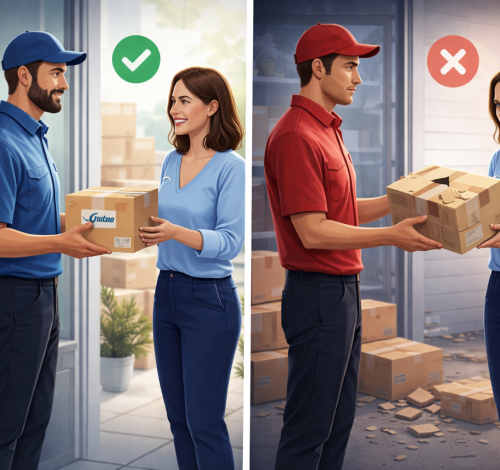
Next comes the quality of the packaging, which is often overlooked even though it speaks for you before the product is even visible. A damaged box, sloppy packaging or a parcel that is too big for its contents are details that make an impression. Not a positive one. 📦
Finally, delivery reliability closes the loop. Delivered on time, to the right place, in good condition: this triptych seems obvious. Yet this is precisely where a large part of customer perception comes into play. A parcel that does not arrive on the announced date turns the excitement of the purchase into pure frustration.
The advantages of direct integration: automation for performance
Fortunately, CMS marketplace integrations offer an effective solution to these issues. First, by connecting your logistics system directly to your sales platforms, you benefit from centralised order management that revolutionises your daily routine. This means you no longer need to switch between tabs. Now, all orders automatically arrive in a single dashboard, regardless of their source channel.
What’s more, this centralisation naturally leads to a significant reduction in errors. Automation eliminates the risks associated with manual data entry. At the same time, it guarantees maximum accuracy in order processing. In this way, all information is transferred directly from the CMS to the logistics system. This means that there is no human intervention to introduce inaccuracies.
Finally, and perhaps most tangibly, these integrations generate significant time savings ⏱️. Thanks to this optimisation, teams can focus on tasks with higher added value. At the same time, they can move away from repetitive and time-consuming operations. As a result, this efficiency translates into an increased capacity to process more orders with the same resources. It therefore promotes the growth of the business.
Why the post-purchase experience builds loyalty more than the product itself
It’s a paradox that few companies anticipate: a customer may love your product and never come back, simply because the experience surrounding that product disappointed them. The e-commerce customer experience doesn’t end at the order confirmation page; it actually begins at that point.
The first impression upon receiving the package is often more memorable than the act of purchasing itself. It is the tangible, physical moment when your brand enters the customer’s real life. Careful unboxing, a thoughtful message slipped into the package, packaging consistent with your visual identity, these elements create an emotion that no advertising campaign can replicate. 🎁
Furthermore, confidence in delivery times plays a much more significant role than it may seem. A customer who knows exactly when their order will arrive is not only reassured, they are available. Available to buy again, to recommend, to trust again. This predictability is one of the strongest foundations of customer loyalty.
That’s why parcel tracking and proactive communication are not just technical options. They are a form of respect for the customer. Keeping them informed at every stage, saving them from having to search for answers themselves, notifying them of a delay before they discover it themselves, it’s these little touches that turn a casual buyer into a loyal customer. ✉️
How Futurlog secures the customer experience after the sale
This is precisely the area on which Futurlog has built its approach. Not just by shipping parcels, but by taking care of everything that constitutes a successful e-commerce customer experience after the sale.
Everything is based first and foremost on controlled processes. Each order follows a specific protocol, from receipt at the warehouse to delivery to the carrier. This rigour eliminates human error, reduces processing times and guarantees consistent service, regardless of the volume to be processed. Because when it comes to e-commerce logistics, consistency is just as important as performance. ⚙️
Next, optimised transport makes all the difference in e-commerce delivery. Choosing the right carrier based on destination, weight and desired delivery time is an expertise in itself. Futurlog integrates this directly into its processes to guarantee reliable, cost-competitive deliveries that meet the expectations of each end customer.
Finally, visibility into performance enables continuous improvement. Thanks to detailed dashboards, e-merchants have real-time access to the indicators that matter: on-time delivery rates, error rates, average delivery times. This transparency is at the heart of logistics optimisation, enabling us to quickly identify what works, correct what doesn’t, and make continuous progress.
Ultimately, the e-commerce customer experience is built as much after the sale as before. Brands that understand this do not treat logistics as an operational constraint, but rather as a lever for differentiation. And in a market where consumers have choice, it is often what happens after the click that determines whether they will return. 🎯
 Faq
Faq
 Faq
FaqAs soon as volumes increase and manual management starts to generate errors or wasted time, integration becomes a key lever. Even with just a few hundred orders per month, connecting your logistics to your CMS and marketplaces makes operations more reliable, saves time and allows you to calmly prepare for increased demand.
No. With Futurlog, integrations are native and designed to be quick to set up. Orders, stock and delivery statuses are synchronised automatically, without any heavy development or technical management on the brand side. The goal is simple: smooth implementation without disrupting existing business.
Brands immediately gain operational efficiency: fewer errors, real-time visibility of stock, centralised orders and automated customer tracking. By outsourcing their logistics to Futurlog, they can focus on growth, marketing and customer experience, while relying on a scalable and reliable infrastructure.