
Connecting your logistics to your CMS and marketplaces: the game changer in e-commerce
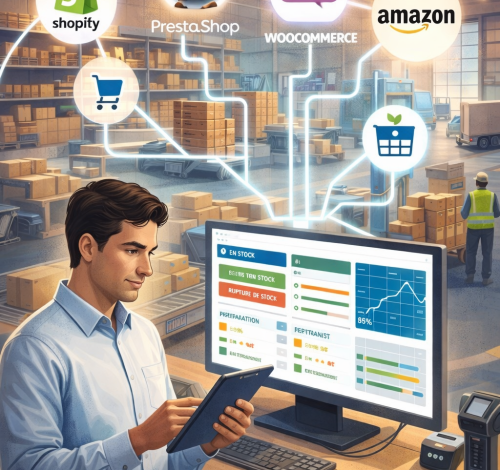
In the world of e-commerce, manually managing orders, inventory and shipments represents a considerable waste of time for brands. However, between different sales platforms, management systems and logistics tools, the risk of error increases and productivity decreases. Nevertheless, there is a solution that can radically transform this reality: CMS marketplace integrations that automate the entire supply chain.
The limitations of an unconnected system: a barrier to growth
When a business operates without connectivity between its various tools, it quickly encounters major obstacles. First, manually entering orders from Shopify, PrestaShop, WooCommerce, or Amazon inevitably leads to processing errors. In fact, each platform requires separate management. This increases the risk of oversights or duplicates.
Furthermore, the lack of CMS marketplace integrations prevents real-time data synchronisation. As a result, teams must constantly juggle between multiple interfaces. On the one hand, they manually check stock levels. On the other hand, they update order statuses on each sales channel. This fragmentation of processes not only generates frustration. It also leads to high operational costs and a poor customer experience.
The advantages of direct integration: automation for performance
Fortunately, CMS marketplace integrations offer an effective solution to these issues. First, by connecting your logistics system directly to your sales platforms, you benefit from centralised order management that revolutionises your daily routine. This means you no longer need to switch between tabs. Now, all orders automatically arrive in a single dashboard, regardless of their source channel.
What’s more, this centralisation naturally leads to a significant reduction in errors. Automation eliminates the risks associated with manual data entry. At the same time, it guarantees maximum accuracy in order processing. In this way, all information is transferred directly from the CMS to the logistics system. This means that there is no human intervention to introduce inaccuracies.
Finally, and perhaps most tangibly, these integrations generate significant time savings ⏱️. Thanks to this optimisation, teams can focus on tasks with higher added value. At the same time, they can move away from repetitive and time-consuming operations. As a result, this efficiency translates into an increased capacity to process more orders with the same resources. It therefore promotes the growth of the business.
How Futurlog integrates with your sales platforms: a turnkey solution
In concrete terms, Futurlog offers native integrations with the main e-commerce players. So whether you use Shopify for its simplicity, PrestaShop for its flexibility or WooCommerce for its WordPress ecosystem, the connection is smooth and intuitive 🔗. Similarly, if you sell on Amazon and other marketplaces, the same simplicity applies.
- Furthermore, these integrations enable two-way synchronisation of essential data:
- Automatic import of orders from all your sales platforms
- Real-time stock updates to avoid shortages and overselling
- Automatic transmission of tracking numbers to customers via their purchasing platform
In this respect, this holistic approach transforms your e-commerce ecosystem into a coherent and efficient system. As a result, CMS marketplace integration is no longer a technical option. On the contrary, it becomes a real strategic lever that positions your business on the path to scalability.
Ultimately, connecting your logistics to your CMS and marketplaces is much more than just an operational improvement. Above all, it is a profound transformation of your management model. It frees up time, reduces errors and optimises the customer experience. In a context where responsiveness and accuracy make all the difference, CMS marketplace integrations are the game changer we’ve been waiting for. In short, they allow brands to focus on their core business: growing their business and satisfying their customers 💡.
 Faq
Faq
 Faq
FaqAs soon as volumes increase and manual management starts to generate errors or wasted time, integration becomes a key lever. Even with just a few hundred orders per month, connecting your logistics to your CMS and marketplaces makes operations more reliable, saves time and allows you to calmly prepare for increased demand.
No. With Futurlog, integrations are native and designed to be quick to set up. Orders, stock and delivery statuses are synchronised automatically, without any heavy development or technical management on the brand side. The goal is simple: smooth implementation without disrupting existing business.
Brands immediately gain operational efficiency: fewer errors, real-time visibility of stock, centralised orders and automated customer tracking. By outsourcing their logistics to Futurlog, they can focus on growth, marketing and customer experience, while relying on a scalable and reliable infrastructure.