
Alternative to Amazon FBA: what solutions for e-commerce brands facing rising costs?
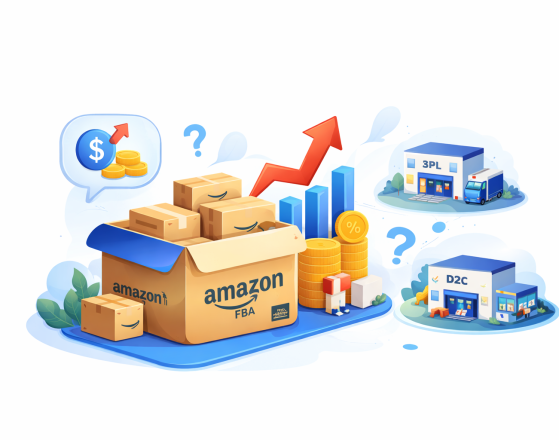
Amazon is an exceptional sales channel. No one can deny it. Millions of buyers. Immediate visibility. Established customer trust. But here is the trap: entrusting all its logistics to a single platform can quickly become an obstacle to profitability and flexibility.
Indeed, what seems practical at the start often turns into an expensive dependency. Amazon FBA offers seductive simplicity. Yet, this simplicity has a price. A price that increases each year, which eats away at your margins and limits your strategic autonomy. In other words, the initial facility hides an economic reality that is much less flattering over time.
Why are more and more brands looking for an alternative to Amazon FBA?
The movement is discreet but massive. Hundreds of e-commerce brands are currently reassessing their logistics strategy. They are looking for alternatives to Amazon FBA. And for a good reason: the reasons for this migration are multiple and convergent.
First of all, the gradual increase in logistics costs on the platform has become unsustainable for many. Every year, Amazon adjusts its rates. More expensive storage. Preparation costs increased. Penalties for dormant stock multiplied. As a result, what seemed competitive three years ago is no longer competitive today. 📊
Moreover, the reduced margins with accumulated fees gradually stifle profitability. Between storage, preparation, transport and marketplace commissions, some brands see 40 to 50% of their sale price go as fees. Consequently, the economic model becomes fragile. A poor stock rotation is enough to tip into the red.
Then, the dependence on a single actor creates a major strategic vulnerability. What happens if Amazon changes its conditions? If your products are suspended following a customer complaint? If the algorithm penalizes you? Thus, you have no fallback solution. Your business is in the hands of a platform on which you have no leverage. 🎯
Finally, the lack of personalization and mastery of customer experience frustrates brands that have invested in their identity. Standardized packaging. Limited communication. Generic tracking. In short, your product arrives like all the others, in an Amazon box, without any touch that recalls your brand. Moreover, this standardization dilutes your differentiation and weakens your brand capital.
The limits of a 100% Amazon model for logistics
Beyond costs, it is the structural rigidity of the model that poses a problem. Because Amazon FBA was not designed to serve your strategy. It was designed to serve that of Amazon.
Firstly, the low flexibility on processes and deadlines deprives you of commercial agility. Do you want to test a new packaging? Impossible without redoing your entire inventory. Do you want to offer an express delay on your site? Difficult if your stock is locked at Amazon. As a result, each business initiative faces logistical constraints that you do not control. In other words, it is your logistics that drive your marketing, not the other way around.
Secondly, the difficulty of developing other sales channels in parallel limits your growth potential. Your stock is on Amazon. Difficult to sell efficiently on your Shopify. Complicated to feed other marketplaces. Impossible to serve retail customers. Therefore, you are locked into a single-channel model while modern growth requires omnichannel. Moreover, this concentration on a single market weakens your business resilience.
Thirdly, the complexity of taking back control of your flows becomes an obstacle if you want to evolve. Repatriating your stock from FBA is expensive. Reorganizing your supply chain takes time. Rebuilding your knowledge of real costs takes months. Thus, the longer you stay, the harder it becomes to leave. In sum, it is a system that encourages dependency rather than autonomy. ⚙️
Finally, the loss of global visibility on your logistics performance deprives you of optimization levers. You do not see the details of your actual costs. As a result, you do not easily compare your performance with other solutions and you cannot test other carriers. Therefore, you are subjugated rather than piloted. In other words, you pay without really knowing if you are paying the right price.
The alternative: outsourced and independent e-commerce logistics
Faced with these limits, a new generation of brands is making a different choice. That of an independent e-commerce logistics, outsourced to specialized providers. This approach offers four decisive advantages that transform Amazon logistics into a simple option rather than a bond.
First, the multi-carrier to optimize costs and deadlines radically changes the economic equation. Rather than being subject to the rates of a single actor, you benefit from your provider’s negotiation with several partners. Colissimo, Chronopost, DPD, Mondial Relay: each shipment is entrusted to the most efficient carrier for this destination. As a result, you simultaneously optimize your costs and deadlines. Therefore, your profitability improves without sacrificing quality of service. 📦
Then, the best mastery of brand image and packaging becomes possible. You choose your packaging. You personalize your packages and integrate marketing inserts and a memorable unboxing experience. Thus, each delivery strengthens your identity rather than diluting it. Moreover, this differentiation becomes a loyalty lever that the FBA model simply does not allow.
Furthermore, the ability to manage multiple channels simultaneously unlocks your growth potential. A single stock feeds your site, your marketplaces, your physical points of sale, your resellers. You sell everywhere without duplicating your inventory. Therefore, you maximize your turnover rate while expanding your commercial presence. In other words, your logistics becomes an omnichannel facilitator rather than a brake.
Finally, a more agile structure to support growth gives you the freedom to experiment. New market? Your logistics follows. New product? The infrastructure absorbs. Seasonal peak? Resources adapt. Thus, your business decisions are no longer constrained by your logistical capacity. In short, you regain control of your development trajectory. 🚀
How Futurlog positions itself as a credible alternative to Amazon FBA
It is precisely in this space that Futurlog built its model. Not like a competitor of Amazon. But as an Amazon FBA alternative that gives back to brands what they have lost: autonomy, profitability, and flexibility.
Firstly, the independent and flexible logistics platform constitutes the foundation of this proposal. Infrastructure sized to absorb growth. Scalable processes that adapt to the specificities of each brand. Technological tools that simplify management. As a result, you benefit from the power of a professional infrastructure without the rigidity of a standardized system. In other words, you have the best of both worlds: performance and customization.
Secondly, the real-time management of flows and performances gives you back the visibility that is so lacking on FBA. Intuitive dashboard. Complete traceability. Detailed performance indicators. Automatic alerts. Therefore, you know exactly what happens, at any time, on each order. Thus, you regain control over your supply chain. Moreover, this transparency allows you to continuously optimize rather than endure. 💡
Thirdly, the support adapted to brand growth makes all the difference between a transactional provider and a strategic partner. Futurlog doesn’t just ship. He advises on possible optimizations, anticipates future needs and adapts to changes in the business model. Therefore, you build a long-term relationship with an actor who understands your challenges. In short, it is a partner that grows with you, not just a logistics service provider.
Finally, the continuous optimization of transport and preparation costs guarantees sustainable competitiveness. Regular carrier negotiations. Constantly refined processes. Technologies that automate to reduce costs. Thus, your Amazon FBA cost from yesterday becomes a benchmark that Futurlog strives to beat. As a result, the economic equation shifts in your favor. In other words, you reclaim margins without sacrificing quality.
Conclusion: efficient logistics, growth lever
Ultimately, Amazon FBA is not bad. It’s simply a tool among others. A tool that has its advantages, but also its limitations. For brands that aim for profitable and sustainable growth, exploring an alternative to Amazon FBA is no longer an option. It is a strategic necessity.
Because the real power does not lie in the platform you use. It lies in your ability to choose, compare, optimize. And this freedom, only an independent e-commerce logistics can guarantee it for you. 🎯
💡 About
Futurlog is the efficient and agile logistics provider that allows e-commerce brands to outsource their logistics with confidence and thus deliver faster and cheaper.
More than 400 brands trust us, why not you?
The real question is not to leave Amazon, but to regain control of your logistics. Many brands confuse sales channel and operational infrastructure. Amazon remains a powerful commercial lever, but entrusting all its logistics to FBA creates a structural dependence that limits the margin, flexibility, and long-term strategy. Working with an independent logistics provider allows you to continue selling on Amazon while controlling your costs, inventory, and customer experience. You keep the channel, but you recover governance.
Yes, and that’s often where the difference lies. The cumulative FBA fees: storage, preparation, transport, commissions, penalties can represent a considerable part of the sale price. An outsourced e-commerce logistics and multi-carrier allows to optimize each position, adapt the flows to the real volumes and avoid hidden costs. Beyond the direct decrease in costs, it is above all the visibility on data and the capacity for continuous optimization that sustainably improve the margin.
The risk lies less in change than in immobility. Remaining dependent on a rigid model while costs increase weakens the structure in the long term. A well-supported transition is prepared, anticipated and secured through structured onboarding and a gradual resumption of flows. The objective is not to create a disruption, but to build a more agile logistics, capable of absorbing growth without degrading the customer experience. An ambitious brand does not seek immediate ease, it seeks lasting solidity.