
Why AI does not replace humans in logistics, but makes them more efficient
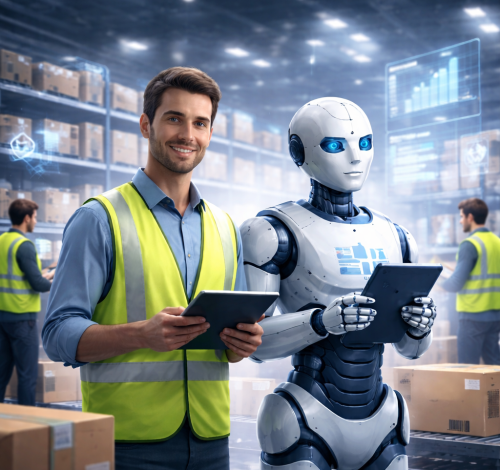
Adoption of AI in logistics is accelerating dramatically. Between stock prediction algorithms, automated routing systems and real-time analysis tools, artificial intelligence gradually invests all links in the supply chain. This technological transformation legitimately raises concerns about the replacement of jobs, particularly in a sector that employs millions of people.
Yet, logistics has a fundamental specificity: it is a complex, physical and non-standardized environment. Each warehouse has its particularities, each product its constraints and each client its requirements. This variability makes AI in logistics a great assistance tool, but certainly not a substitute for human expertise.
What the AI knows very well how to do in logistics 📊
Artificial intelligence excels in several areas that transform operational efficiency. It first allows for a continuous analysis of volumes of data that is impossible to perform manually. Thousands of stock movements, preparation times and carrier performances are simultaneously scrutinized to identify trends and optimization opportunities.
This ability translates into a much faster detection of anomalies and risks. An unusual delay in a carrier, an increase in the error rate or a drift in unit costs: as many signals that the AI spots instantly. Furthermore, the automation of repetitive tasks frees up valuable time, allowing teams to focus on higher value-added missions. Finally, AI in logistics provides valuable assistance with prioritization and decision-making, suggesting the optimal order processing order based on multiple constraints.
Ce que l'IA ne peut pas (et ne doit pas) faire ⚠️
Despite its performance, artificial intelligence runs up against fundamental limits. She cannot handle the unexpected terrain : a stuck cart, a damaged package, or an incomplete address require human judgment that no algorithm can reproduce.
Similarly, AI cannot understand the human and commercial stakes of a brand. Does an order from a VIP client deserve priority processing? Should we delay a shipment to group several packages? These arbitrations require a detailed understanding of the business context that only humans possess. AI also fails to arbitrate in complex or sensitive situations and cannot assume the operational responsibility that remains fundamentally human.
The central role of humans in efficient logistics 👥
Business expertise and field knowledge constitute the irreplaceable foundation of any quality logistics operation. An experienced logistician knows instantly that a particular packaging will be necessary or that a destination requires special attention. This tacit knowledge, acquired through years of practice, cannot be codified in an algorithm.
This expertise is manifested in the ability to arbitrate and contextualize. Faced with the same problem, the optimal solution varies according to the context: urgency, client history, constraints of the moment or strategic objectives. The dimension of customer relations, support and advice also remains the prerogative of human teams. Explain a delay, propose an alternative solution or reassure about quality: so many interactions that create value but require empathy and relational intelligence.
AI + human: the most efficient model 🚀
The real revolution of AI in logistics lies in the power of the AI-human duo. Artificial intelligence works as a help tool, not as a single decision maker: it analyzes, suggests, and alerts, but it is always the human who validates, adjusts, and decides.
This collaboration generates concrete benefits. The saving of time and reliability translates into increased productivity without loss of quality. There is also a reduction in errors and better anticipation of problems. AI detects inconsistencies, signals risks and proposes preventive solutions, transforming logistics from a reactive discipline to a proactive one.
In practice, this complementarity manifests itself through several scenarios. The AI alerts system + human decision illustrates this model: the algorithm detects a problem, but it is the logistics manager who decides on the response taking into account the context. Dashboards enriched by AI allow a much more efficient daily management, while controlled flow automation maximizes both efficiency and quality.
What it changes for e-commerce brands 📦
For brands that adopt this hybrid model, the benefits are immediate. Operational reliability is improving, processes are becoming more robust and deadlines more predictable. This stability translates into fewer incidents visible on the client’s side: delays, shipping errors and stock outs decrease significantly.
Beyond the absence of problems, it is a better overall customer experience that emerges. Deadlines are met, orders arrive in perfect condition and tracking information is accurate. This operational excellence contributes directly to the brand’s reputation and allows for repositioning logistics as a strategic lever rather than a risk.
How Futurlog integrates AI responsibly 🎯
At Futurlog, we have developed a responsible and pragmatic vision of AI in logistics. Our approach is based on the conviction that technology must serve teams and clients, never replace them. Concretely, our technology is always at the service of the teams, and we assume a refusal of the blind “all automated”.
We also guarantee controlled, explained and mastered logistics. Our AI tools never work in a black box: every decision can be explained, every alert contextualized and every process supervised. This transparency ensures that you always keep control of your logistics.
AI amplifies the human, it does not replace him ⚡
The fundamental principles of a successful AI in logistics:
- AI as a smart assistant, not as an autonomous decision maker
- The human being at the heart of strategic decisions and complex arbitrations
- Technology at the service of expertise, not the other way around
AI in logistics does not replace humans, it amplifies their efficiency and ability to act. Logisticians remain at the heart of performance, equipped with tools that allow them to see further, act faster and decide better. This increase directly benefits e-commerce brands who can count on logistics that are efficient, reliable and deeply human.
Are you wondering about the right balance between technology and human expertise ? Let’s discuss your vision and discover how Futurlog combines the best of AI and human know-how. Our team offers you a free audit of your logistics organization.
🔍Faq
Yes, provided that it is used as a decision support tool and not as a stand-alone system. When well integrated, AI allows to analyze data continuously, detect anomalies earlier and prioritize high-impact actions. Combined with human expertise, it improves operational reliability while enhancing service quality, particularly regarding deadlines and exception management.
No, if the technology is designed to be driven and explained. At Futurlog, AI never works in a ‘black box’: each alert, recommendation, or automation remains supervised by expert teams. Brands maintain a clear view of their operations and benefit from better control, not blind delegation.
This model allows to reconcile performance, reliability and customer experience. Brands see fewer visible incidents, more predictable deadlines and better anticipation of peaks in activity. Result: fewer customer service requests, a strengthened brand image and logistics that becomes a real growth lever rather than an operational risk.