
How to align your e-commerce logistics with your growth
In the competitive world of online commerce, many companies attribute their difficulties to logistical failures. However, the reality is often quite different: the real problem is not the quality of logistics, but the ambition of the brand. When a company aims for rapid growth without having structured its operations accordingly, its entire value chain is weakened.
Why so many brands underestimate their logistics potential
Many e-commerce companies start out with temporary logistics solutions, thinking they can adjust their strategy along the way. However, this approach quickly creates three major obstacles that hinder their development.
First, the fear of scaling up gradually sets in. Managers are reluctant to increase their sales volumes for fear of not being able to fulfil orders on time. This apprehension then becomes a glass ceiling that artificially limits the company’s growth.
The advantages of direct integration: automation for performance
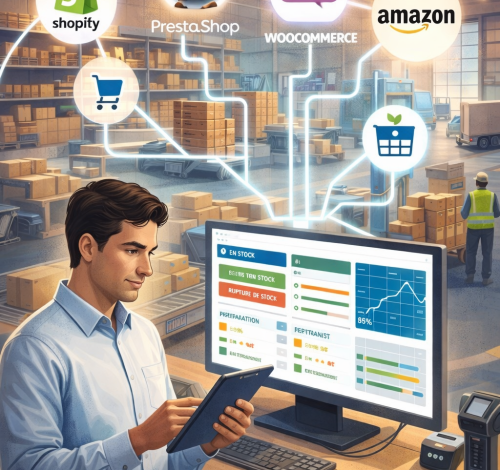
Fortunately, CMS marketplace integrations offer an effective solution to these issues. First, by connecting your logistics system directly to your sales platforms, you benefit from centralised order management that revolutionises your daily routine. This means you no longer need to switch between tabs. Now, all orders automatically arrive in a single dashboard, regardless of their source channel.
What’s more, this centralisation naturally leads to a significant reduction in errors. Automation eliminates the risks associated with manual data entry. At the same time, it guarantees maximum accuracy in order processing. In this way, all information is transferred directly from the CMS to the logistics system. This means that there is no human intervention to introduce inaccuracies.
Next, the operational funnel narrows dangerously. As sales increase, manual processes and inadequate storage solutions create bottlenecks. Teams spend more time managing emergencies than developing the business, which directly impacts customer satisfaction.
Finally, the lack of visibility into data prevents informed decision-making. Without reliable dashboards and real-time performance indicators, it is impossible to anticipate stock shortages, optimise transport costs or identify high-potential products. This strategic blindness compromises the company’s ability to look confidently to the future.
Logistics as a psychological lever for growth
Beyond its operational role, effective e-commerce logistics profoundly transforms the way a company approaches its market. It does more than just deliver parcels: it unlocks growth potential by acting on three essential psychological dimensions.
First, it instils absolute confidence in the processes. When a team knows that every order will be prepared correctly, shipped quickly and delivered on time, it can focus fully on acquiring new customers. This operational peace of mind translates into bolder communication and more ambitious marketing campaigns. 💪
In addition, a robust logistics infrastructure enables much faster decision-making. Entrepreneurs no longer need to manually validate each shipment or constantly check stock levels. This newfound autonomy allows them to seize market opportunities with agility, whether it’s launching a flash promotion or testing a new distribution channel.
At the same time, logistical control leads to a significant reduction in perceived risk. Peak periods are no longer synonymous with chaos but with opportunity. Promotional periods such as Black Friday or sales become strategic moments rather than sources of anxiety, allowing the company to capitalise fully on these key commercial periods.
How Futurlog aligns operations with ambition
Faced with these challenges, the solution lies in choosing a logistics partner who truly understands the challenges of modern e-commerce. Some providers, such as Futurlog, have developed an approach that reconciles operational excellence with strategic vision.
Their philosophy is based on fluid, scalable processes that adapt naturally to the growth of your business. Rather than imposing rigid methods, they design logistics flows that absorb volume variations without compromising service quality.This flexibility ensures that your e-commerce logistics evolve at the same pace as your commercial ambitions.
Access to a real-time dashboard is also a major asset in logistics optimisation. Instantly viewing your stock, tracking each parcel and analysing your performance allows you to anticipate needs and adjust your commercial strategy based on real data from the field. This total transparency eliminates the grey areas that paralyse so many businesses.
Finally, the ability to absorb volumes during periods of high demand makes all the difference between controlled growth and chaotic development. A logistics provider scaled to support e-commerce growth allows you to launch your most ambitious marketing campaigns with confidence, knowing that the infrastructure will follow without fail.
Ultimately, aligning your logistics with your growth is not just a technical issue: it is a strategic choice that determines how far your brand can go. By investing in the right infrastructure and a reliable partner, you can transform your e-commerce logistics from a cost centre into a real driver of growth. It’s time to stop holding back your ambition out of fear of operational constraints and build an organisation capable of supporting your greatest aspirations. 🎯
 Faq
Faq
 Faq
FaqLogistics that work at a given moment are not necessarily suited to tomorrow’s growth.
Many brands encounter their first difficulties not when they start up, but when volumes increase rapidly. Anticipating this allows you to avoid disruptions, delays and disorganisation when business really takes off.
The real question is not ‘are my orders being shipped?’ but:
• Can I absorb twice the volume without disrupting my business?
• Do I have clear visibility into my logistics performance?
• Can I launch marketing campaigns without operational concerns?
If the answer to any of these questions is no, it is probably time to further structure your organisation.
Support is based on three pillars:
• Logistics processes capable of absorbing volumes
• Real-time visibility of operations
• An organisation designed to evolve with the business
The goal is not just to ship parcels, but to build a logistics system capable of supporting your long-term ambitions.